
TEAM WORKFLOW AUDIT · TEAMS OF EIGHT OR MORE
See the whole route of one workflow before automating any of it.
$1,500 USD. Twelve months of up to five inboxes, the map, credited if we build.Paid upfront · Credited if we buildWHAT GETS MEASURED
Both numbers are agreed in writing on day one, and reused afterwards.Measure the work before changing it.


Depending on the agreed workflow, we examine
Volume in a stated periodWorking time and waiting timeStart, completion, and turnaroundTouches and handoffsOwners and approvalsBacklog, where it can be defined
Not every measure exists for every workflow. Setup says which evidence is usable.WHAT GETS MAPPED
Make the full route visible.
Fourteen fields, in order. Missing or disputed answers stay marked: no path finished from assumption.01
Trigger
What starts it, and who sets it off.02Inputs
Documents, data, and messages it needs.03Systems
Where the work is actually done.04People and owners
Named, not job-titled.05Handoffs
Every point where it changes hands.06Decisions
What has to be judged, and by whom.07Approvals
Who is authorised to say yes.08Rules
Written, assumed, or in one head.09Exceptions
Cases that break the route.10Waiting time
Time the work sat still.11Working time
Time someone was on it.12Completion
What everyone agrees is done.13Volume
How often, over the agreed period.14Turnaround
Agreed start to agreed end.Unknown owner, disputed rule, evidence we could not see: marked, never smoothed over.
HOW OPPORTUNITIES ARE RANKED
Rank the work, not the tools.
No single score decides. Three questions sort it: pass one, fail two, it waits.
QUESTION ONE
Does it matter?
Frequency, team time, delay, capacity, turnaround. Twice a quarter can wait.QUESTION TWO
Is the workflow understood?
Boundaries, owners, inputs, rules, and a completion everyone recognises.QUESTION THREE
Can it be bounded?
Stable rules, usable inputs, known exceptions, defined review.Use the simplest appropriate level. Higher autonomy is not inherently better.Tool choice comes last.
What you receive
Six documents. Outputs of the audit, not proof of later improvement.A measured view of one workflow.
01
Current-state workflow map
The agreed route: owners, systems, decisions, approvals, exceptions, completion. Gaps marked.02
Supported baseline
Capacity, turnaround, working and waiting time, only where evidence supports a definition.03
Three ranked improvements
Ordered by evidence and operating fit. Unknowns left visible.04
Human-review boundaries
Judgment, approvals, exceptions, escalation, stop conditions.05
Recommended first implementation
The simplest bounded next build, if one is warranted.06
Fixed-price implementation brief
Scope and acceptance tests. “Build nothing yet” is a valid finding.HUMAN REVIEW AND CONTROLS APPROVAL
 EXCEPTIONThe four DAWN levels →
Keep people where judgment matters.
The map marks every decision, approval, exception, and owner before automation is chosen. Tax, accounting, and advice judgment stay with your people.APPROVALEXCEPTION1
Fixed rules, predictable inputs
May suit deterministic automation. No model needed.2
AI prepares or recommends, a person reviews
The draft is machine work. The send is yours.3
Bounded multistep work needs checkpoints
Named exception paths and a place to stop.4
Some workflows can be designed around AI
Only with clear ownership and controls. The audit switches nothing on.HOW IT RUNS
Measure. Map. Decide what comes next.
1
Scope the audit
Business unit, candidate workflows, usable evidence.2
Measure and map
Routes, handoffs, delays, volume, turnaround, as far as evidence supports.3
Review the opportunities
45 minutes: what to pursue, what stays uncertain, where people stay.4
Choose the next step
Scope a build, gather more evidence, or stop. Stopping is a real answer.Five business days after access and evidence are validated. Anything beyond one workflow, one unit, five inboxes, or twelve months gets a separate scope.Start my Team Workflow Audit
FIT
Built for work that crosses a team.
Trust is earned one workflow at a time.A good fit looks like
A team of eight or moreRepeated work that crosses people or systemsLeadership able to sponsor access and decisionsA preference for measuring before implementing
Accounting and tax firms
EXAMPLES, NOT CLIENT RESULTSClient onboardingDocument collectionStatus updatesAssignmentsReviewsDeadlinesSeasonal capacity
Where audits get pointed. Examples, not client results.Straight answers
Scope, price, what we need from you, and what happens when the answer is “don’t build it.”
No. The free audit inspects one inbox. This one measures and maps a workflow across a team: different scope, different price.
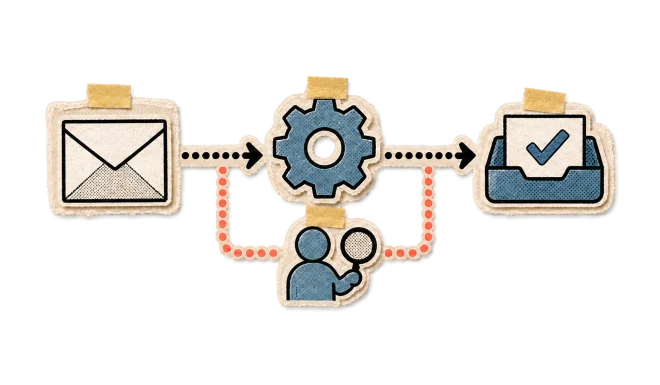
See the whole workflow before choosing what to automate.
Twelve months of up to five inboxes, $1,500 USD upfront. Anything outside that gets its own scope.TEAM WORKFLOW AUDIT · $1,500 USDSee the whole route of one workflow before automating any of it.Twelve months of up to five inboxes, the map, credited if we build.Start my Team Workflow AuditPaid upfront · Credited if we build
One person sees a task. The team reveals the workflow.
Personal AI use helps with a task. It cannot show where work starts, who touches it, what waits, or what counts as done.RequestWhere does it start, and how many arrive in a week?OwnerWho picks it up, and who assumed someone else had?HandoffHow long does it sit between two desks?Decision, stays with a personWho is allowed to decide, and what happens when they are out?CompletionWhat counts as done, and who agrees it is?
Measure the work before changing it.
Capacity
How much work the team got through in a set stretch of time.Turnaround
How long one piece of work takes from landing to done, waiting included. A measure, not an improvement.Depending on the workflow
Volume in a stated periodWorking time and waiting timeStart, completion, and turnaroundTouches and handoffsOwners and approvalsBacklog, where it can be defined
Not every measure exists for every workflow. Setup decides which evidence is usable.WHAT GETS MAPPED
Make the full route visible.
01
Missing or disputed answers stay marked.Trigger
What starts it, and who sets it off.02Inputs
Documents, data, and messages it needs.03Systems
Where the work is actually done.04People and owners
Named, not job-titled.05Handoffs
Every point where it changes hands.06Decisions
What has to be judged, and by whom.07Approvals
Who is authorised to say yes.08Rules
Written, assumed, or in one head.09Exceptions
Cases that break the route.10Waiting time
Time the work sat still.11Working time
Time someone was on it.12Completion
What everyone agrees is done.13Volume
How often, over the agreed period.14Turnaround
Agreed start to agreed end.Rank the work, not the tools.
Does it matter?
Frequency, team time, delay, capacity, turnaround.Is the workflow understood?
Boundaries, owners, inputs, rules, completion.Can it be bounded?
Stable rules, usable inputs, known exceptions, defined human review.Use the simplest appropriate level.Higher autonomy is not inherently better. Tool choice comes last.
What you receiveNo dashboard, portal, or ongoing reporting unless separately contracted.
A measured view of one workflow.
Current-state workflow map
The agreed route, with gaps marked.Supported baseline
Only where evidence supports a definition.Three ranked improvements
Ordered by evidence, unknowns visible.Human-review boundaries
Judgment, approvals, exceptions, stop conditions.Recommended first implementation
The simplest bounded build, when warranted.Fixed-price implementation brief
“Build nothing yet” is a valid finding.Keep people where judgment matters.
APPROVALEXCEPTION1
Fixed rules, predictable inputs
May suit deterministic automation.2
AI prepares, a person reviews
The draft is machine work. The send is yours.3
Bounded multistep work
Checkpoints and named exception paths.4
Designed around AI
Only with clear ownership and controls.Measure. Map. Decide what comes next.
1
Scope the audit
Business unit, candidate workflows, usable evidence.2
Measure and map
Routes, handoffs, delays, volume, turnaround.3
Review the opportunities
45-minute findings session.4
Choose the next step
Scope implementation separately, gather more evidence, or stop.Built for work that crosses a team.
A good fit looks like
A team of eight or moreRepeated work crossing people or systemsLeadership able to sponsor access and decisionsA preference for measuring before implementingAccounting and tax firms
Client onboardingDocument collectionStatus updatesAssignmentsReviewsDeadlinesSeasonal capacity
EXAMPLES, NOT CLIENT RESULTSStraight answers
No. The free audit inspects one inbox. This one measures and maps a workflow across a team: different scope, different price.

 YouTube
 LinkedIn
 TikTok
 Instagram
 Facebook
 Substack